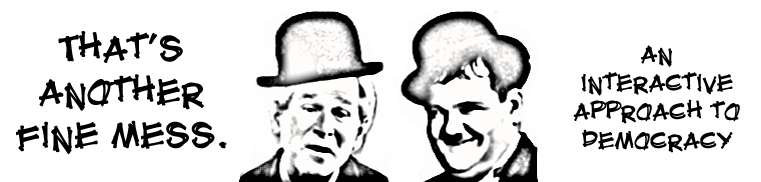

I Don't Like Where This is Going
By: Ryan Oddey
"Those who give up essential liberty, to preserve a little temporary safety, deserve neither liberty nor safety." These words were spoken by Benjamin Franklin prior to the Revolutionary War Although this statement was first uttered centuries ago, the message still stands true. The sentiment voiced by Franklin is something we should all remember when we take a look at the actions and nominations of President George W. Bush.
Mr. Bush has taken actions that may appear to preserve America?s safety through his appointments of hardliners to diplomatic positions, but this sense of security will not last as our nation goes down a long and lonely road towards isolationism. Although President Bush has claimed to be a uniter, and not a
divider, the truth is that he is the latter.
George W. Bush has divided this nation, and his recent nominations will divide the United States of America from the rest of the world. Bush is not a diplomat, Bush is not a great
leader; he is a radical right revolutionary who would rather lay the groundwork for a Republican dynasty within America instead of
rebuilding strong international ties in the hopes of a better tomorrow. The President says he is making America safer, but in the end the long term outlook of Bush international policy will raise hostility towards the United States.
The key evidence that points towards Bush?s position as a radical right revolutionary. as well as his international intentions, was most recently seen over the last few months in the form of nominations of persons for positions that they should not have. Furthermore, these nominations prove one of the most
despicable facts about President Bush, that he is a hypocrite.
On Tuesday, February 22, 2005, President Bush attended a NATO summit in Belgium where he declared a "new era of trans-Atlantic unity between the U.S. and Europe. " This sentiment was echoed by new Secretary of State Condoleeza Rice in a trip she had made to Europe earlier that month. In spite of calling for stronger relations with Europe, President Bush has made policy moves that will continue to push away our neighbors around the globe.
The nomination of John Bolton to the United Nations is one glaring example of Bush?s ideology of undermining international organizations and alienating the United States from the rest of the world. John Bolton is on record saying the following: (courtesy of StopBolton.org
"[M]any Republicans in Congress--and perhaps a majority--not only do not care about losing the General Assembly vote but actually see it as a 'make my day' outcome. Indeed, once the vote is lost?? this will simply provide further evidence to why nothing more should be paid to the UN system."
The Washington Times 1998
"There is no such thing as the United Nations. There is an international community that occasionally can be led by the only real power left in the world and that is the United States when it suits our interest and we can get others
to go along."
1994 Global Structures Convocation, New York, NY.
"General Assembly Resolutions and international conference declarations, (such as the Universal Declaration of Human Rights, Agenda 21, and the Millennium Declaration) are 'mind-numbing.'"
Policy Review. "Bring Back the Laxalt Doctrine," 2000.
"If I were redoing the Security Council today, I'd have one permanent member because that's the real reflection of the distribution of power in the world."
National Public Radio with Juan Williams, 2000.
"The Senate vote [on the Comprehensive Test Ban Treaty] is also an unmistakable signal that America rejects the illusionary protections of unenforceable treaties."
The Jerusalem Post, 1999.
"Renouncing the Rome Statute of the International Criminal Court was 'the happiest moment of my government service.'"
The Wall Street Journal, 2002.
"Support for the International Criminal Court concept is based largely on emotional appeals to an abstract ideal of an international judicial system."
Statement before the House International Relations Committee, 2000.
"We do not support the promotion of international advocacy activity by international or non-governmental organizations, particularly when those political or policy views advocated are not consistent with the views of all member states.?
Statement to the UN Conference on the Illicit Trade in Small Arms and Light Weapons in All its Aspects, 9 July 2001. This stands in stark contrast to the official policy of the United States, which is to support and strengthen the involvement of non-governmental organizations in international processes.
The only explanation for promoting a man who has made these statements to a position of international diplomacy is to let every other nation in the world know that we are not interested in working with them. If they want to work FOR US, fine, otherwise, according to Bush, we don?t need you. Even worse,
President Bush believes that taking this approach towards the United Nations will make America safer. He could not be more wrong.
Former United States Ambassador to the U.N. Richard Holbrooke was recently quoted as saying: "If we continue to under-fund, under-support, and undermine the U.N. system it will become progressively weaker and at the same time it will become
increasingly a center for hostility to the United States, a combination, a trifecta if you will, that will hurt American national security interests in many ways."
This statement is important when you consider that the deeper the wedge between the United States and the rest of the world, the less likely the rest of the world will be likely to help assist in different programs, such as the ones designed to take out terrorists and share crucial information. Thus hurting
our national security. Or perhaps we alienate enough nations to the point where they no longer want to participate in purchasing our bonds, thus harming our financial security.
America isn?t the only one that would suffer from alienating the United Nations. Holbrooke added: "A weaker U.N. is one where the human rights commission is dominated by such terrible violators as Cuba and Libya," he said. "In other words, what is wrong with the U.N. or the human rights commission, is not the core ideas that it stands for but the instances where due to lack of American engagement and leadership the institution was hijacked by states whose practices are anathema to all the U.N. stands for."
The opportunity is there for us to lead the world by means of working with every nation around the globe. Instead, President Bush has developed an agenda where the United States is trying to force the rest of the world to go yield to our will. It will not work and yet in spite of the fallacy of this plan, Bush continues to carry on with it.
The recent nomination of Under-Secretary of Defense Paul Wolfowitz shows just how disinterested President Bush is in establishing ties with Europe. Wolfowitz gave testimony to congress prior to the war in Iraq and stated that Iraq was a nation that would be ready, willing, and able to rebuild in a short time following the war. Wolfowitz also added that Iraq would have its own funds to use for the rebuilding process. Obviously this was not true and Wolfowitz either lied to congress or was so far off in his assessment that he has no place heading the World Bank.
The war in Iraq is not the only red flag in the political history of Paul Wolfowitz. During the term of George H.W. Bush, Wolfowitz was the Under Secretary of Defense and in this position he outlined a policy that encouraged the United States to use pre-emptive force. Furthermore, he argued that the United States should act alone when necessary. How can a man with such an isolationist approach the world be tapped to lead an international organization? The bigger question, how can Bush keep thinking this approach is in the best interest of the United States?
Bush continues to follow these policies because he has surrounded himself with ex-Trotskyists, now known as the ?neocons.? These people, including Vice President Dick Cheney and World Bank Presidential Nominee Paul Wolfowitz, subscribe to the theory of permanent revolution. Although the permanent revolution theory was first developed for the Soviet Union, we can see how the Bush administration has adopted its ideals. Most notably, the concept that the United States needs to be involved in the revolution and rebuilding of other countries so that the newly rebuilt nations will match up ideologically.
Thus we see a domino theory. If we can force enough nations to adopt our ideals it will force other nations to either join in the permanent revolution or risk being left behind. It is a way to try and force the will of the rest of the world and by nature, it is a militaristic disposition. Thus we see how Cheney and Wolfowitz can be considered Trotskyists if we consider their political history, most recently, the war in Iraq.
The problem with the Trotsky approach to international relations is that it is such a huge gamble. The Soviet Union tried to force its will on other nations in the hopes that they would adopt Russian policy and it did not work. The end result was the implosion of the Soviet Union. I believe the United States could realistically face a similar outcome. For those of you who would suggest that the Soviet Union had the super power of the United States to contend with and thus conclude that since we are the lone super power left nothing should stand in our way I offer you this: China is fast becoming another super power, but I believe the continued development of the Europan Union could result in super power status. Add in the fact that the United
States continues to see its respect drop within the international community and suddenly you have a lot of countries who want nothing to do with American Policy.
This is not the fault of America, or American society, it is the sole responsibility of President Bush and his administration. They are trying to roll the dice with the rest of the world, and force them to conform to our ideals and our interests. The longer Bush tries to force his will on the rest of the world, the worse the fall out will be.
Considering what happened to the Soviet Union, it is not impossible to believe that if this policy continues for a long enough time, it could lead to revolution within the United States. Perhaps the blue states of the northeast will grow tired of being a part of a constant war machine and call for secession. It happened in the Soviet Union.
I will concede that the likelihood of secession is minute, but because it is not an impossible idea it helps illustrate just how damaging Bush policy is overseas and at home. Unfortunately, too many people see Bush as someone who went into Iraq with the sole agenda of regime change. The reality, is that Iraq was not the end of a regime, but the beginning phases of an idea destined to try and change the world and force every other nation on the planet to essentially bend to our will.
Bush does not care about the people of Iraq, he is more concerned with trying to recreate the world so that it fits his and other neoconservatives? ideals. Now that Iraq is taken care of, we are flirting back and forth with going to war with Syria or Iran. If Bush cared about the safety of the world, North Korea
would have been on the top of the list. Instead, Bush went into the Middle East, in the name of his own revolution, not freedom.
Wolfowitz, Bolton, and other American "diplomats" are just pieces in the puzzle that is beginning to take shape. The sooner we all wake up and realize exactly what is going on here, the sooner we will be to ending this madness. And believe me, we need to take care of this sooner rather than later, before the United States of America becomes the next evil empire.
Article added
at 8:58 PM EST
Updated: Saturday, March 19, 2005 12:10 AM EST


